
Hello!
Thanks for your interest in understanding how there can be a neurodivergent nuance to how each Enneagram Type understands and meets their motivation. As I continue to build out this website, please feel free to ask questions, share thoughts, offer improvements, and use any excuse to talk to me about the Enneagram!
The AUTIStic NUANCE
Autism is not a single presentation, personality, or way of being — it’s a neurological difference that shapes how a person experiences the world. When we layer the Enneagram onto autism, there is an important nuance to understand: neurodivergent nervous systems process stress, sensory input, and emotional regulation differently than neurotypical ones. This doesn’t change a person’s Enneagram type, but it does change how that type shows up. Understanding this nuance is essential if we want to use the Enneagram as a tool for support rather than misinterpretation.
Autism, Dysregulation & Chronic Stress
Autistic individuals often experience the world as a more demanding and unpredictable place than their peers. Sensory input, social expectations, transitions, and uncertainty can push their nervous systems into dysregulation more quickly — and more often. As a result, autistic children may live closer to stress states for much of their day, even when things appear “fine” on the outside. When we understand this baseline stress, we stop asking, “Why is this happening?” and start asking, “What support is needed right now?”
Why enneagram-informed support matters
The Enneagram helps us understand why someone reacts the way they do under stress — not just what the behavior looks like. When applied through a neurodiversity-affirming lens, Enneagram wisdom allows parents, educators, and caregivers to tailor support strategies that align with a child’s underlying motivation, fears, and regulation needs. Instead of one-size-fits-all accommodations, we can offer support that actually helps an autistic child feel safer, more understood, and more capable of re-regulating. This is where insight turns into compassion — and compassion turns into effective support.
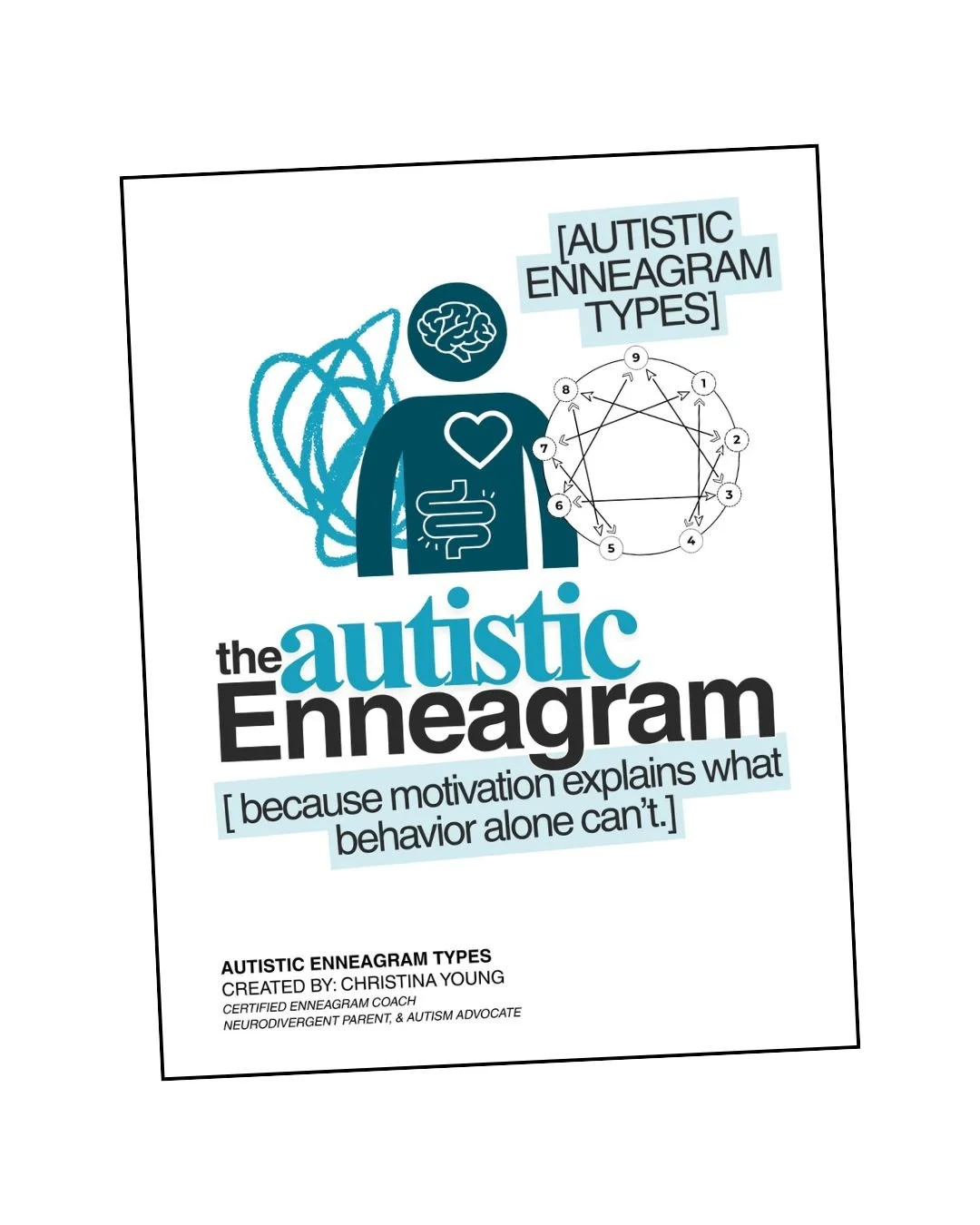
How Autism Can Show Up Differently by Enneagram Type
Autistic individuals express Enneagram patterns in ways that may look different from traditional descriptions — and that difference matters. For example, an autistic Enneagram Type may experience stress responses more intensely, skip emotional stages entirely, or show behaviors that are often misunderstood as “out of character” for that type. These variations are not contradictions; they are adaptations shaped by neurodivergent nervous systems. Learning how each Enneagram type can uniquely express autism opens the door for more accurate teaching, better support strategies, and fewer harmful assumptions.